Shelby County officials have faced criticism recently in the wake of a cashflow crunch and the Tennessee Comptroller’s decision not to approve its Fiscal Year 2026 budget.
But what hasn’t been reported anywhere is a big win for the county that was unlocked by a small group of commissioners who refused to budge on the tax rate.
Here’s a condensed playback:
Following hours of debate, the commission adopted a 2.69 property tax rate. This is the state-certified rate equivalent to 3.39, the previous fiscal year’s rate, after factoring for the results of the reassessment.
Why is that important? Because it unlocked something historic.
For the first time in 23 years, Shelby County does not have the highest property tax rate in the state.
Shelby County government has had the highest property tax rate statewide since 2003, but this year we dropped from first to fourth.
We’re no longer the highest-taxed county. Huzzah!
To keep it that way, local officials will need to prioritize essential services, eliminate waste and make some tough decisions. To do so, they’ll need a clear understanding of our finances.
Below are 11 charts that paint a picture of Shelby County’s financial status.
1 – Counties by property tax rate
Every county’s property tax rate, from lowest to highest. Shelby County is displayed in red. Neighboring counties of Fayette and Tipton are labeled for context.
2 – County tax rates (grouped)
The property tax rate for almost half of counties falls between 1.50 and 1.99. Shelby County’s group is displayed in red.
3 – Tennessee counties by tax rate and population
According to the latest census data, Shelby remains the largest county in Tennessee. But Metro Nashville/Davidson’s tax rate has edged ahead.
4 – Property tax rate history
The four-year reappraisal cycle produces a state-certified rate, displayed in blue. County officials can set a rate that is higher, lower or equivalent to the certified rate. There was an additional “recapture” rate set for Shelby County in fiscal year 2023.
5 – Property tax receipts
Property tax collections have steadily increased over time, independent of rate increases or decreases.
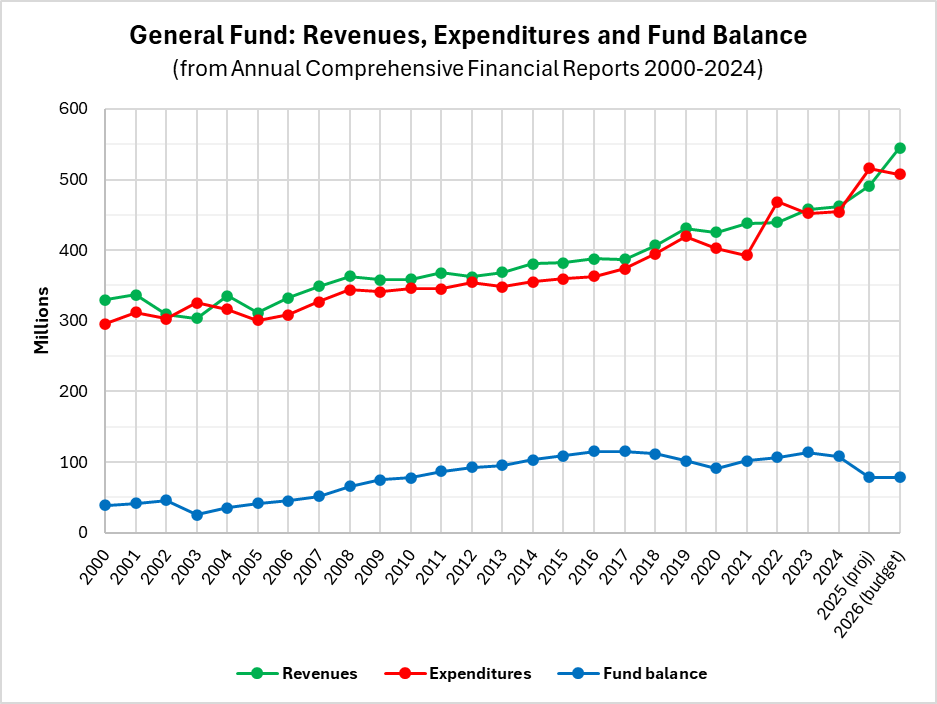
6 – General fund revenues, expenditures and fund balance
General fund revenues (in green) should generally rest above expenses (in red), so that the fund balance (in blue) is high enough to endure lean months and emergencies.
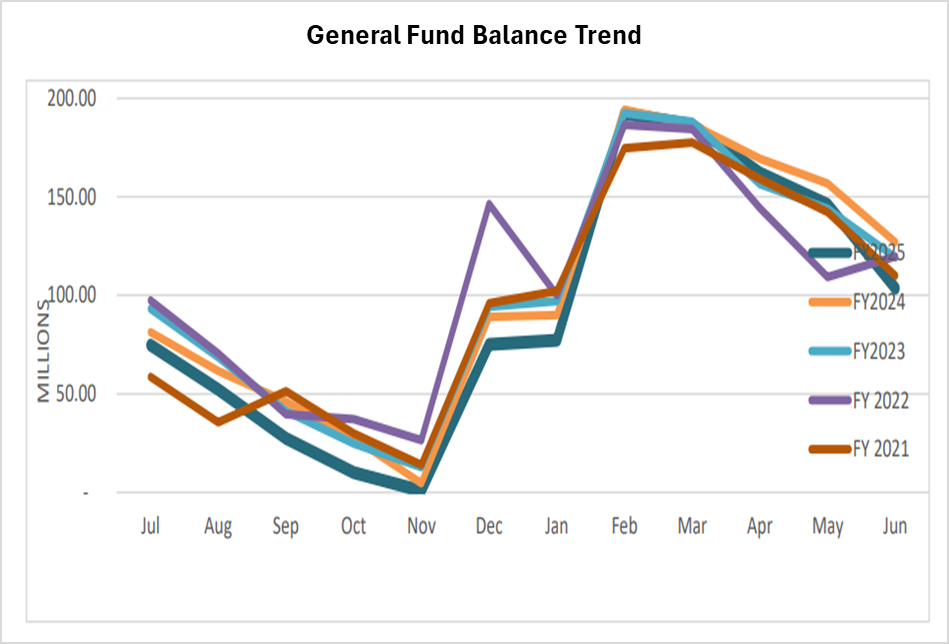
7 – General fund balance trend
The bulk of property taxes are collected December through February, leaving the county’s general fund at its lowest point every November. This is important context for the cashflow crunch Shelby County faced in November 2025. Without a sufficient balance in the general fund, the county was forced to temporarily borrow from other funds to meet payroll and pay its bills until tax revenues arrived.
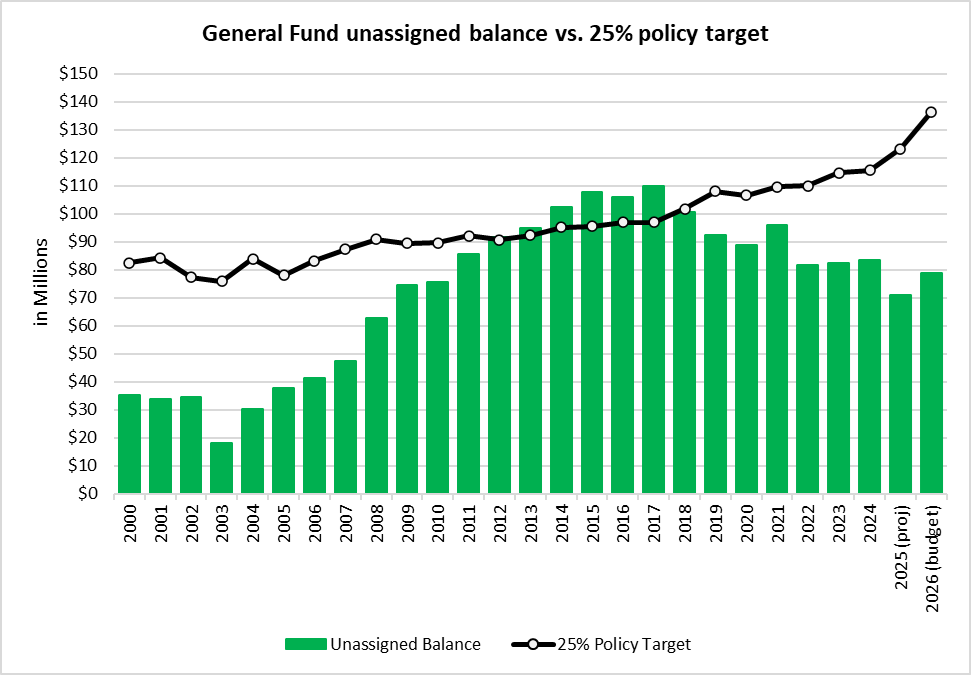
8 – Unassigned fund balance
By policy, Shelby County is supposed to keep 25% of its tax collections in the general fund on reserve. Since 2000, the county has only met that target a handful of times. The gap is what creates a cashflow crunch, such as the one in November 2025.
9 – Shelby County debt
The county’s long-term debt is driven by Capital Improvement Project (CIP) spending and the interest rate on the money borrowed to fund such projects. This chart, taken from the budget book, shows long-term debt in total (blue), alongside debt specific to school construction (green), and other projects such as county roads, buildings and other projects (orange). The county’s debt peaked at around $1.8 billion in 2007. Debt service is paid with a fraction of the county’s property tax revenues and a portion of the county’s motor vehicle privilege tax.
10 – CIP spending
Shelby County’s long term debt is held in check by the county’s CIP spending policy, which is currently capped at $150 million annually, doubled from $75 million in FY24. Over the next 20 years, this spending level would total $3 billion, covering only a third of an estimated $10 billion in infrastructure costs Shelby County could face over that period, including schools, Regional One and the jail/criminal justice center.
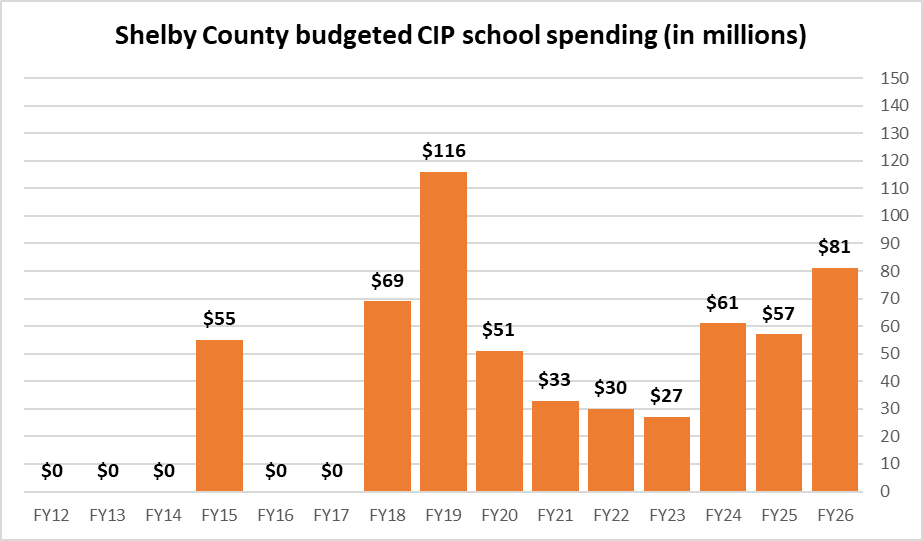
11 – CIP spending (schools)
Spending on school construction was zeroed out in fiscal years 2012-2014 during the merger/de-merger, and again in 2016-2017 while awaiting a school building facilities plan. Lower spending on school building maintenance and construction, paired with aging infrastructure and the lack of an approved facilities plan, has resulted in large deferred maintenance totals at MSCS. The county has started to catch up by more than doubling school construction spending in recent years.
Bonus chart: Shelby County maintained roads and Bridges
It’s important to note that the county’s CIP spending on roads and bridges is confined to the areas of the map shaded yellow (unincorporated Shelby County).
See posts from 2020 and 2022 for previous versions of these charts.